
Personal balance sheet vs net worth: what's the difference, and why it matters
You know the number. Do you know what it's made of?
Your net worth is a single number. Your balance sheet is the statement that produces it, and only one of the two can tell you whether you can actually afford the coastal house.
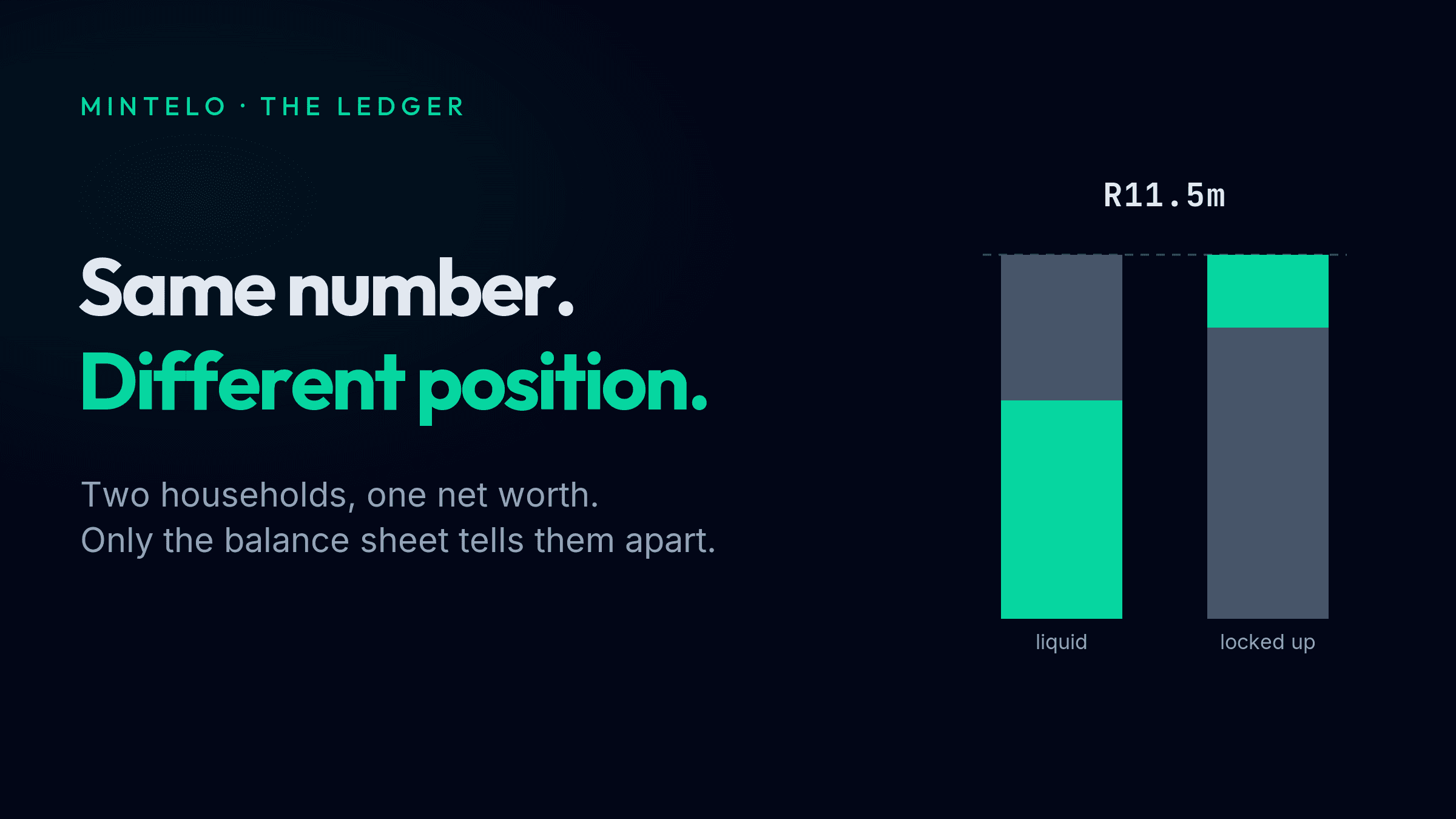
Two households, one net worth. The scalar can't tell them apart; the balance sheet can.
You know your net worth. Say it is R11.5m. It went up this year, which felt good. Now answer a harder question: can you afford to buy the coastal house? Not "is R11.5m a lot", but can you, specifically, write that cheque without selling something you would rather keep or borrowing at a rate you would rather not pay?
If you cannot answer that from the number alone, you have just found the gap between net worth and a balance sheet. It is the same gap our cornerstone on tracking wealth honestly opens with, and it is worth being precise about, because most people use the two terms as if they were the same thing. They are not. One is a number. The other is the statement that produces the number and keeps everything the number throws away.
Net worth is a scalar. The balance sheet is the structure
Net worth is a single figure: everything you own minus everything you owe. Assets minus liabilities. That is the whole definition, and it is a good one as far as it goes.[1]
A balance sheet, in formal accounting the statement of financial position, is the structured statement that arrives at that same figure by laying out the pieces.[2] It has three parts, and they are tied together by an identity that never stops being true: Assets = Liabilities + Equity. Equity here is just the accounting word for the residual left after you subtract what you owe from what you own, which is to say, equity is your net worth.[3] "Net worth" is the personal-finance label for the same residual that business accounting calls equity.[4]
So net worth is not a different thing from your balance sheet. It is the bottom line of your balance sheet, compressed into one number. And compression loses information. That is the entire point of this article.
What the single number quietly throws away
Take two people. Both report a net worth of exactly R11.5m. On the scalar, they are identical. On a balance sheet, they might be living completely different financial lives:
One holds R600,000 in cash and money-market balances. The other holds R120,000. Same net worth, wildly different liquidity: how much of that wealth is reachable this week without selling a house or breaking a retirement annuity.
One has R11.5m spread across local equities, offshore holdings, a home and a retirement fund. The other has R10m of it sitting in a single property. Same net worth, very different concentration: how exposed you are to one asset, one sector, or one currency going wrong.
One owns their assets outright. The other reports R11.5m net worth on R18m of assets against R6.5m of debt. Same net worth, very different leverage, and a very different night's sleep when interest rates move.
The scalar cannot distinguish any of these. The balance sheet keeps all of them, because its classified structure is what carries information about liquidity, leverage and asset mix in the first place.[2] The bundling of "what a single number loses" into those four headings (liquidity, concentration, leverage, asset mix) is my own framing rather than a quoted authority, but each piece of it is exactly what the statement's structure is built to preserve.
Which is why the person who knows only their net worth cannot answer the coastal-house question, and the person who reads their own balance sheet can. The answer was never in the total. It was in the composition.
The five pieces every balance sheet is built from
Accounting recognises five building blocks, called in the standards the five elements of financial statements: assets, liabilities, equity, income and expenses.[5] The first three live on the balance sheet; the last two live on the income statement, which is a separate scorecard for a separate question. For a household the mapping is intuitive once you see it:
Assets: cash, money-market balances, local and offshore investments, a retirement annuity, a tax-free savings account, the home, the car, money owed to you.
Liabilities: the bond, vehicle finance, the credit-card balance, any loan you have to settle.
Equity: the residual. Your net worth.
Group your own numbers under those headings and you have built a personal balance sheet. Total the assets, total the liabilities, subtract, and the equity line at the bottom is your net worth, reached in a way that shows its working. Our balance sheet builder does exactly this grouping for you if you would rather not start from a blank page.
A worked household, so this is not abstract
Consider a single household we use across this whole series: rand-only, reasonably diversified, the kind of position many Mintelo readers actually hold. Its opening balance sheet totals R13,160,000 in assets against R2,725,000 in liabilities, leaving an opening net worth of R10,435,000. The assets are not one blob: cash and money-market of R600,000, local and offshore brokerage accounts, a retirement annuity, a tax-free savings account, a primary residence at R4,500,000, a vehicle, and a loan account owed back from a family trust.[6]
A year later, net worth has grown to R11,535,180: assets of R14,072,724 against liabilities of R2,537,544.[6] On a net-worth tracker, that is a single line moving from R10.4m to R11.5m. On a balance sheet, you can see where the movement happened: which assets rose, which debt was paid down, how much is now liquid, how concentrated the property position has become. The scalar tells you the score changed. The statement tells you the game.
The personal balance sheet is an adaptation. Say so plainly
One honest caveat, because it is the sort of thing this audience notices when it is glossed over. There is no accounting standard that governs a personal balance sheet. IFRS and its equivalents write the rules for companies and other reporting entities, not for households.[3] The personal balance sheet borrows the assets-minus-liabilities structure by analogy, and it is a sound, well-worn analogy, taught by personal-finance educators as a self-assessment tool, but it is not an external requirement, and nobody is auditing yours.[7]
That matters for one practical reason: because there is no standard, you decide the conventions, from how you value the house to whether you carry the car at market value to how you treat unrealised gains. The discipline is worth having precisely because it is voluntary. (South Africans above the SARS high-net-worth threshold do have to file a statement of assets and liabilities with their return, but that is a tax requirement, not an accounting standard, and a separate conversation.)
So what does this mean in practice?
Net worth is a fine headline. It is a genuinely useful single number for tracking whether you are, broadly, getting richer over time. But it is a headline, and you would not run a business off a single headline figure with no statement behind it. The moment your wealth lives in more than a handful of places, a few accounts, some offshore exposure, a property, a bit of debt, the composition starts to matter as much as the total, and the composition is exactly what the scalar discards. Building the balance sheet behind your net worth is the five-minute move that turns "the number went up" into "here is what actually happened, and here is what I can actually do." It is where treating your own wealth like a company you happen to own quietly begins, and it is the whole reason we built Mintelo to hold your numbers to the standard a company holds its own books.
About the author
Rian Cronje comes to personal finance from the outside. After 25 years in corporate finance, in Group Financial Controller roles, multi-currency consolidations and digital transformation, the unglamorous rigour of making a business's accounts actually reconcile, he found almost none of that discipline had reached the way individuals track their own wealth. He is not an advisor; he has nothing to sell you about where to put your money. He built Mintelo to close that gap: to hold a person's wealth to the standard a company holds its own books, and to break down the jargon that keeps capable people, him once included, locked out of their own numbers.
Sources
AccountingTools, "Net worth definition." accountingtools.com/articles/net-worth (accessed 23 Jun 2026).
Corporate Finance Institute, "Balance Sheet." corporatefinanceinstitute.com/resources/accounting/balance-sheet/ (accessed 23 Jun 2026).IFRS Foundation, Conceptual Framework for Financial Reporting (2021), para 4.63 (equity is the residual interest in assets after deducting liabilities); paras 4.3 and 4.26 (asset and liability definitions). ifrs.org (accessed 23 Jun 2026).
Britannica Money, "Personal Balance Sheet: How to Calculate Your Net Worth." britannica.com/money/personal-balance-sheet (accessed 23 Jun 2026).
IFRS Foundation, Conceptual Framework for Financial Reporting (2021), para 4.1 (the five elements: assets, liabilities, equity, income, expenses). ifrs.org (accessed 23 Jun 2026).
Mintelo worked household (rand-only), balances verified in code to R0.00 at open and close: opening assets R13,160,000 / liabilities R2,725,000 / equity R10,435,000; closing assets R14,072,724 / liabilities R2,537,544 / equity R11,535,180. Full detail in Cornerstone 1.
MoneyManagement.org, "How To Create a Personal Balance Sheet and Determine Your Net Worth." moneymanagement.org (accessed 23 Jun 2026).
See your real net worth across every account, in rand or dollar.
One reconciled view, the same number whichever way it's checked. Mintelo is the personal wealth platform built like a real one.