
How often should you rebalance, and how do you track the drag?
Am I rebalancing for a better return, or for a risk I actually chose?
There is no provable optimal rebalancing frequency — and anyone who sells you one is selling. What the evidence does support is humbler and more useful: rebalancing is for risk control, and its real cost is measurable.
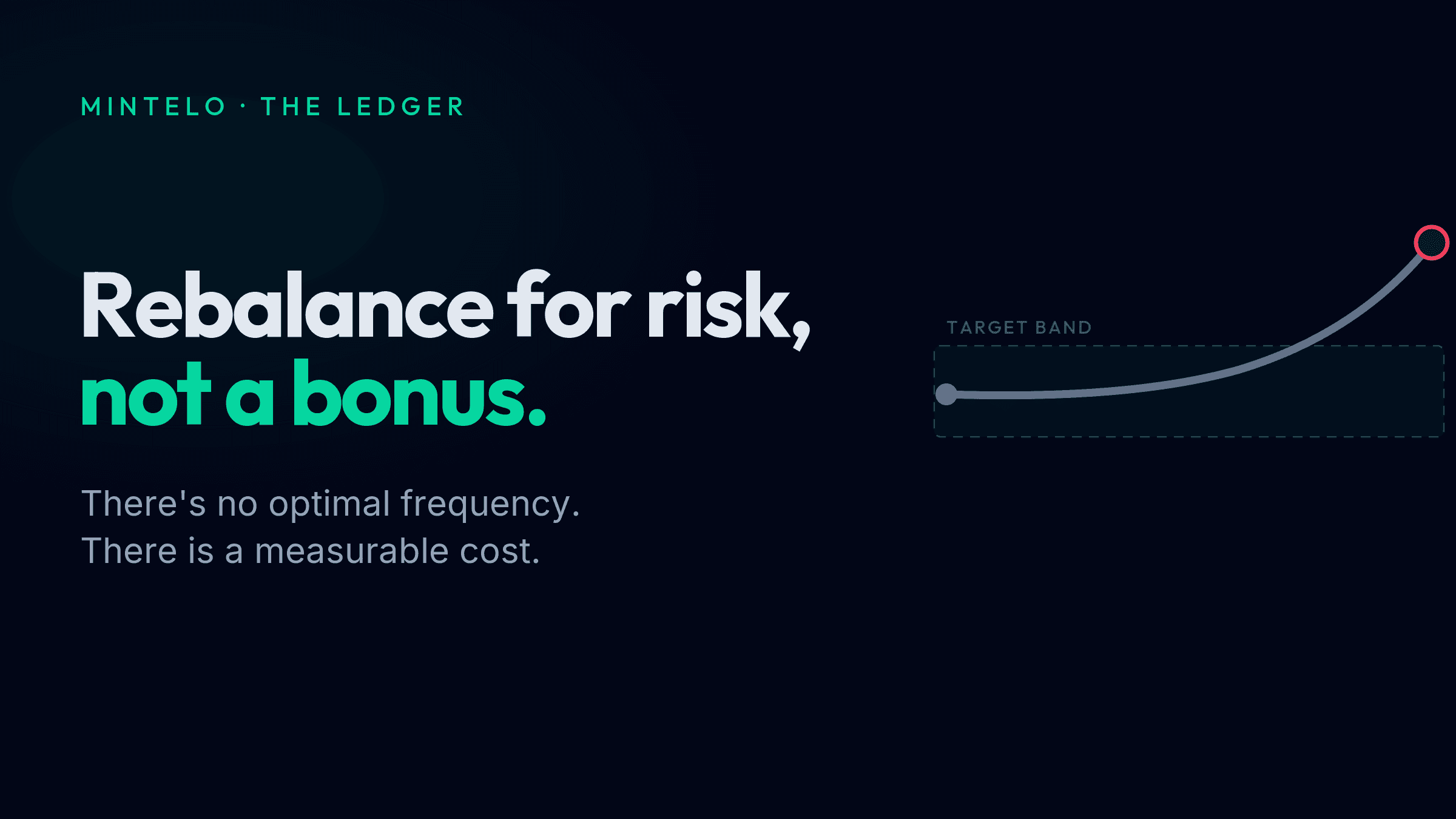
Left to drift, a portfolio quietly takes on risk you never chose — that's what rebalancing controls.
How often should you rebalance, and how do you track the drag?
The honest answer to "how often should I rebalance?" is one most articles will not give you: there is no provable optimal frequency, and the evidence says there is not one to find. That is not a cop-out — it is the finding. What the evidence does support is more useful than a magic number: rebalancing is primarily a tool for controlling risk, not boosting return, and its real cost is something you can measure on your own portfolio.
This is a companion to our cornerstone on how investment return is actually calculated. Once you can measure return honestly, you can measure what rebalancing costs you against the return you would have had without it.
Drag is near-certain; the "bonus" is not
Two terms get confused, and keeping them apart is the whole article.
Rebalancing drag is the return you lose to the act of rebalancing: transaction costs — commission, the bid-ask spread, market impact — and, in taxable accounts, the tax you trigger by selling appreciated assets. These costs are near-certain. Every time you rebalance, you pay them.
The rebalancing bonus — sometimes called the diversification return, a term tracing to Booth and Fama's 1992 work — is a potential benefit from systematically trimming what has risen and topping up what has fallen.[1] The word that matters is potential. The bonus is positive when relative asset prices mean-revert, and it can be negative in persistently trending markets, where you keep selling the winner just as it keeps winning.[2] It depends on how the assets behave, not on the act of rebalancing itself. So the cost is reliable and the benefit is not — which is exactly backwards from how rebalancing is usually sold.
What rebalancing is actually for
If the bonus is not dependable, why rebalance at all? Because rebalancing controls risk, and that is its real job.
Vanguard's foundational study, using US stock and bond data from 1926 to 2009, reached a conclusion worth quoting plainly: "there is no optimal frequency or threshold when selecting a rebalancing strategy."[3] Risk-adjusted returns were not meaningfully different across monthly, quarterly or annual rebalancing — but the number of rebalancing events, and the costs, rose with frequency. A portfolio that was never rebalanced did earn a higher raw return — a 60/40 mix drifting to over 84% equities and returning 9.1% — but only because it had quietly become a much riskier portfolio, with volatility of 14.4% against roughly 12% for the rebalanced version.[3] The extra return was compensation for extra risk the investor never chose. That is the point of rebalancing: not to earn more, but to keep the portfolio at the risk level you actually decided on.
A more recent Vanguard study, from December 2024, estimates that a threshold-based policy (rebalance when an allocation drifts past a band) can edge out a calendar-based one by roughly 11 to 18 basis points a year — but it is careful about where that comes from: mainly lower transaction costs and better drift control, not a return-generating bonus.[4] Treat that as a Vanguard estimate from simulation, not a law. The direction is plausible; the precise figure is not a promise.
So the practical guidance the evidence supports is modest: monitor your allocation perhaps annually or semi-annually, act when it has drifted past a tolerance you set in advance (a band of around five percentage points is a common, defensible choice), and lean toward less-frequent action when taxes and costs apply. No calendar maximises return. Several reasonable policies control risk about equally well.
How to measure your own drag
The abstract numbers matter less than what rebalancing costs you. Measure it against the counterfactual of not rebalancing — or rebalancing less often — and sum the frictions you actually incur:
Transaction costs. Commission plus the bid-ask spread on every trade the rebalance requires. On liquid funds this is small; on thinly traded holdings it is not.
Tax drag. In a taxable account, selling an appreciated asset to rebalance realises a capital gain and triggers tax — often the largest single cost of rebalancing, and one that is near-zero inside tax-sheltered wrappers. The tax mechanics are South-Africa-specific and we defer the detail to a dedicated treatment, but the principle is general: rebalancing in a taxable account is far more expensive than the same trade in a sheltered one, and that difference should change how often you do it.
The risk-and-return comparison. Run your actually-rebalanced portfolio's return and its volatility against a drifted, un-rebalanced version over the same window. The honest accounting is not "did rebalancing make me more money" — often it did not — but "did it hold my risk where I wanted it, and what did that cost?" Both halves of that sentence are the answer.
The tactic that cuts the drag
There is one move that gets most of the risk-control benefit at a fraction of the cost, and it is the one worth building a habit around: rebalance with your cash flows. Instead of selling the overweight asset, direct new contributions, dividends and interest into the underweight one. You move the allocation back toward target without realising a single gain, which sidesteps both the transaction cost of selling and — crucially in a taxable account — the tax.[3] For anyone still contributing regularly, this alone can do most of the rebalancing work the portfolio needs, quietly, between any formal review.
To conclude
Stop looking for the optimal rebalancing frequency; the evidence is clear that there is not one. Rebalance to control risk, not to chase a return bonus that the data shows is conditional and sometimes negative. Set a tolerance band, review once or twice a year, and use your incoming cash flows to do the heavy lifting so you rarely have to sell. Then measure what it actually costs you — transaction costs, tax in taxable accounts, and the risk-and-return comparison against a portfolio you left to drift. The discipline is not in the calendar. It is in knowing the cost is real, the bonus is not promised, and the reason you are doing it at all is the risk level you chose on purpose.
About the Author
Rian Cronje comes to personal finance from the outside. After 25 years in corporate finance — Group Financial Controller roles, multi-currency consolidations and digital transformation, the unglamorous rigour of making a business's accounts actually reconcile — he found almost none of that discipline had reached the way individuals track their own wealth. He is not an advisor; he has nothing to sell you about where to put your money. He built Mintelo to close that gap: to hold a person's wealth to the standard a company holds its own books, and to break down the jargon that keeps capable people — him once included — locked out of their own numbers.
Sources
Diversification-return lineage (Booth & Fama, 1992): Willenbrock, "Diversification Return, Portfolio Rebalancing, and the Commodity Return Puzzle." arxiv.org (accessed 19 Jun 2026).
AQR (Huss & Maloney), "Portfolio Rebalancing — Common Misconceptions" — the rebalancing bonus is not guaranteed and can be negative in trending markets. aqr.com, Feb 2017 (accessed 19 Jun 2026).
Vanguard (Jaconetti, Kinniry, Zilbering), "Best Practices for Portfolio Rebalancing," 2010 — "no optimal frequency or threshold"; the never-rebalanced 60/40 drifting to >84% equity at higher risk; the cash-flow rebalancing tactic. Corroborated by AAII summary, aaii.com (both accessed 19 Jun 2026).
Vanguard (Zhang et al.), "The Rebalancing Edge," Dec 2024 — threshold-based policy estimated to edge calendar-based by ~11–18 bps/yr, driven mainly by lower transaction costs. Simulation-based; presented as a Vanguard estimate, not established fact. corporate.vanguard.com (accessed 19 Jun 2026).
See your real net worth across every account — in rand or dollar.
One reconciled view, the same number whichever way it's checked. Mintelo is the personal wealth platform built like a real one.